Why Websites Often Fail to Deliver ROI Despite Investment
Websites frequently underperform on ROI not because the web is inherently difficult, but because organizations invest heavily in visible assets such as redesigns, CMS changes, feat


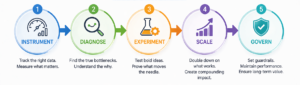
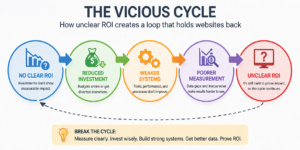
| Area | Common Overlooked Mistake | Why It Kills ROI | Evidence Signals / Benchmarks | Fast Detection |
| Technical Performance | Shipping heavy pages (JS bloat, large assets, no performance budgets) | Slower load times (LCP, INP) increase abandonment and reduce conversion; also increases paid CAC | Median page weight increasing year over year; high JS dependency across sites | Core Web Vitals, Lighthouse, RUM data |
| UX (Conversion Journeys) | Long, complex checkout flows; hidden guest checkout; unnecessary form friction | Drop-offs at highest intent stage, directly impacting revenue | Majority of ecommerce checkouts rated mediocre or worse | Funnel step conversion, session recordings, field-level drop-off |
| UX (Product Discovery) | Poor filters, weak product listing UX, lack of comparison clarity | Users cannot find or evaluate products efficiently despite intent | High percentage of sites underperform in discovery benchmarks | Search logs, filter usage, product page exits |
| Accessibility | Ignoring accessibility basics (contrast, labels, navigation) | Excludes users, reduces usability quality, increases friction | High error rates across audited homepages | Accessibility audits, automated scans |
| Content / Messaging | Unclear value proposition; content not aligned to user intent | Users cannot quickly understand value, reducing trust and conversion | Homepage clarity strongly impacts engagement and conversion | Scroll depth, CTA interaction, on-site search |
| Marketing Alignment | Sending traffic to generic or mismatched landing pages | Intent mismatch reduces conversion efficiency and wastes paid spend | Landing relevance impacts Quality Score and conversion | Campaign-level analysis, bounce rates |
| Analytics / Attribution | Broken tracking, duplicate events, consent misconfig, bot traffic | Data becomes unreliable, leading to incorrect decisions | Measurement gaps increasing due to privacy changes | Tag audits, validation tests |
| Strategy & Operating Model | Project-based redesigns instead of continuous optimization | Improvements do not compound; learning is lost | Organizations without experimentation systems underperform | No KPI ownership, no testing backlog |
| Lever | What Changed | Observed Outcome | Notes on Causality & Transferability |
| Speed Optimization | Improved page load speed (even small gains) | Higher conversion rates, better funnel progression, improved engagement | Strong correlation across industries; impact varies by baseline |
| Performance Governance | Linking performance metrics to business KPIs | Reduced drop-offs as speed improves; better prioritization | Helps align technical work with business outcomes |
| Performance Operations | Cross-functional teams focused on speed improvements | Significant improvements in conversion-related metrics | Requires coordination across teams |
| Faster Navigation | Preloading, faster transitions between pages | Lower exit rates and higher conversions | High impact in multi-step journeys |
| Core Web Vitals Optimization | Improved LCP, INP, CLS | Significant uplift in conversion and engagement | Impact depends on implementation quality |
| Checkout Simplification | Reduced friction, simplified flow, guest checkout | Higher completion rates and revenue | One of the highest impact areas |
| Usability Improvements | User-centered redesign and testing | Large improvements in key business metrics | Impact varies based on baseline UX maturity |
| Experimentation Discipline | Continuous A/B testing and iteration | Compounding revenue growth over time | Requires consistent experimentation culture |
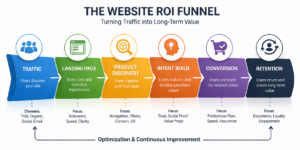 Most ROI loss does not happen at the top of the funnel.
It happens when:
Most ROI loss does not happen at the top of the funnel.
It happens when:
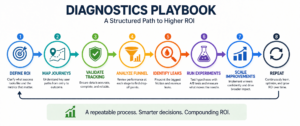
| Priority Test | Hypothesis | Primary KPI | Guardrails | Execution Approach |
| Improve LCP on key pages | Faster load improves conversion | Conversion rate | Bounce rate, errors | A/B test or phased rollout |
| Checkout friction removal | Simpler flow increases completion | Checkout rate | AOV, support tickets | Step-level testing |
| Product discovery UX | Better filters improve engagement | Add-to-cart rate | Page performance | Template-level testing |
| Value proposition clarity | Clear messaging improves CTR | CTA clicks | Bounce rate | A/B copy testing |
| Landing page alignment | Better intent match improves conversion | Conversion rate | Campaign quality | Campaign-level testing |
| Phase | Focus | Effort | Impact |
| Phase 1 | KPI definition, tracking validation | Low–Medium | High (clarity) |
| Phase 2 | Performance + checkout improvements | Medium | High (quick wins) |
| Phase 3 | Experimentation system | Medium–High | High (growth engine) |
| Phase 4 | Scaling improvements | Ongoing | Compounding ROI |
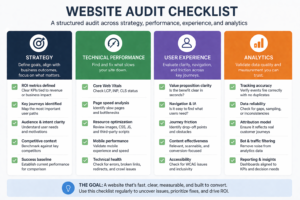
Websites frequently underperform on ROI not because the web is inherently difficult, but because organizations invest heavily in visible assets such as redesigns, CMS changes, feat
Many businesses reach a stage where their website starts getting consistent traffic, but conversions do not improve at the same pace. At first, everything appears to be working wel
Many e-commerce websites focus on broad keywords to increase visibility and bring more traffic. Terms like “running shoes” or “sports shoes” are commonly targeted because o
Many businesses invest in building a visually appealing website, expecting it to generate traffic, leads, and sales. While a good design helps create a strong first impression, it
Search rankings can change overnight, and for many website owners, this feels confusing and frustrating. One of the major reasons behind sudden ranking drops is a Google spam updat
If you are working on SEO in 2026, you have probably come across the term E-E-A-T quite often. It stands for Experience, Expertise, Authoritativeness, and Trust. While it may sound
Over the past few months, one question keeps coming up in almost every marketing discussion: Has AI replaced SEO? With tools like ChatGPT, Perplexity, AI search results, and voice
An SEO audit is the process of analyzing your website to identify issues that may be affecting its visibility in search engines. It helps you understand why your website may not be
Local search has become one of the biggest drivers of customers for small businesses across Indian cities. Whether someone is searching for a dentist in Delhi, a jewellery store in